


Page 64 - Plastics News May 2026
P. 64
PRODUCT NEWS


          HEAT-STABLE ENZYME ADVANCES

          PET RECYCLING


                 esearchers from Tokyo University of Sci-       flexibility at the active site. This combination is
                 ence have characterized a thermophilic         typically difficult to achieve.
          Rcutinase enzyme to better understand
          how biocatalysts can operate under conditions         Thermophilic enzyme model and analytical
          relevant to polyethylene terephthalate (PET) re-      approach
          cycling. The study examines how structural sta-       The research team analyzed a cutinase de-
          bility and local flexibility are balanced to main-    rived  from  the  fungus  Chaetomium  thermophi-
          tain catalytic activity at elevated temperatures.     lum. Both the native enzyme (CtCutWT) and a
                                                                mutant variant (CtCutS136A) were examined.
                                                                Structural characterization and thermal stability
                                                                measurements were conducted using differen-
                                                                tial scanning calorimetry across a temperature
                                                                range from 30 °C to 100 °C.

                                                                Rigid core and flexible lid loop


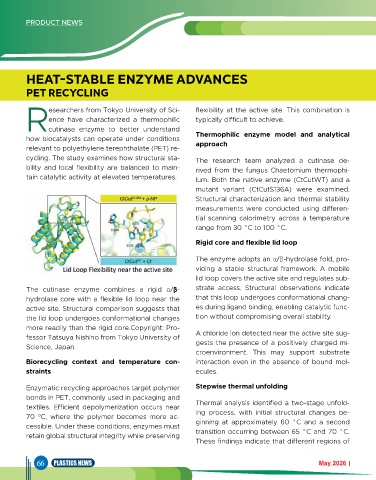
                                                                The enzyme adopts an α/β-hydrolase fold, pro-
                                                                viding a stable structural framework. A mobile
                                                                lid loop covers the active site and regulates sub-

          The cutinase enzyme combines a rigid  α/β-            strate access. Structural observations indicate
          hydrolase core with a flexible lid loop near the      that this loop undergoes conformational chang-
          active site. Structural comparison suggests that      es during ligand binding, enabling catalytic func-
          the lid loop undergoes conformational changes         tion without compromising overall stability.
          more readily than the rigid core.Copyright: Pro-
          fessor Tatsuya Nishino from Tokyo University of       A chloride ion detected near the active site sug-
          Science, Japan.                                       gests the presence of a positively charged mi-
                                                                croenvironment. This may support substrate
          Biorecycling context and temperature con-             interaction even in the absence of bound mol-
          straints                                              ecules.


          Enzymatic recycling approaches target polymer         Stepwise thermal unfolding
          bonds in PET, commonly used in packaging and
          textiles. Efficient depolymerization occurs near      Thermal analysis identified a two-stage unfold-
          70  C, where the polymer becomes more ac-             ing process, with initial structural changes be-
             0
          cessible. Under these conditions, enzymes must        ginning at approximately 60  °C and a second
          retain global structural integrity while preserving   transition occurring between 65 °C and 70 °C.
                                                                These findings indicate that different regions of


             66   PLASTICS NEWS                                                                         May 2026

