


Page 59 - Plastics News May 2026
P. 59
TECHNOLOGY NEWS


                                                                                rial  consistency  directly  affects
                                                                                downstream performance.

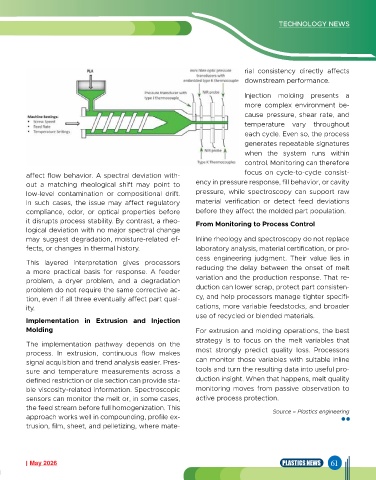
                                                                                Injection  molding  presents a
                                                                                more complex environment be-
                                                                                cause  pressure,  shear  rate,  and
                                                                                temperature vary throughout
                                                                                each cycle. Even so, the process
                                                                                generates repeatable signatures
                                                                                when the system runs within
                                                                                control. Monitoring can therefore

          affect flow behavior. A spectral deviation with-                      focus on cycle-to-cycle consist-
          out a matching rheological shift may point to         ency in pressure response, fill behavior, or cavity
          low-level contamination or compositional drift.       pressure, while spectroscopy can support raw
          In such cases, the issue may affect regulatory        material verification  or detect feed deviations
          compliance, odor, or optical properties before        before they affect the molded part population.
          it disrupts process stability. By contrast, a rheo-   From Monitoring to Process Control
          logical deviation with no major spectral change
          may suggest degradation, moisture-related ef-         Inline rheology and spectroscopy do not replace
          fects, or changes in thermal history.                 laboratory analysis, material certification, or pro-
                                                                cess engineering judgment. Their value lies in
          This layered interpretation gives processors
          a  more  practical  basis  for  response.  A  feeder   reducing the delay between the onset of melt
          problem, a dryer problem, and a degradation           variation and the production response. That re-
          problem do not require the same corrective ac-        duction can lower scrap, protect part consisten-
          tion, even if all three eventually affect part qual-  cy, and help processors manage tighter specifi-
          ity.                                                  cations, more variable feedstocks, and broader
                                                                use of recycled or blended materials.
          Implementation in Extrusion and Injection
          Molding                                               For extrusion and molding operations, the best
                                                                strategy is to focus on the melt variables that
          The implementation pathway depends on the
          process. In extrusion, continuous flow makes          most strongly predict quality loss. Processors
          signal acquisition and trend analysis easier. Pres-   can monitor those variables with suitable inline
          sure and temperature measurements across a            tools and turn the resulting data into useful pro-
          defined restriction or die section can provide sta-   duction insight. When that happens, melt quality
          ble viscosity-related information. Spectroscopic      monitoring moves from passive observation to
          sensors can monitor the melt or, in some cases,       active process protection.
          the feed stream before full homogenization. This                               Source – Plastics engineering
          approach works well in compounding, profile ex-
          trusion, film, sheet, and pelletizing, where mate-


           May 2026                                                                          PLASTICS NEWS  61

