


Page 63 - Plastics News - April 2026
P. 63
BUSINESS NEWS


          With the foundation of the knowledge base,            Learning from the LCEI Database
          researchers created an automated workflow             The resultant plastics LCEI database provides in-
          combining prompt engineering and LLM-driven           sights into research priorities. By plotting gaps
          information extraction. This process resulted in      in the data, researchers can visualize where re-
          a structured database for LCEI in the plastics in-    search is lacking. For example, emerging tech-
          dustry.                                               nologies such as chemical recycling have scarce
                                                                data. For policymakers, this lack of evidence
          Overcoming Bias in Data                               may be a barrier to incentivizing the diversifica-
                                                                tion of plastics end-of -life strategies.
          A database is only as useful as its source data.


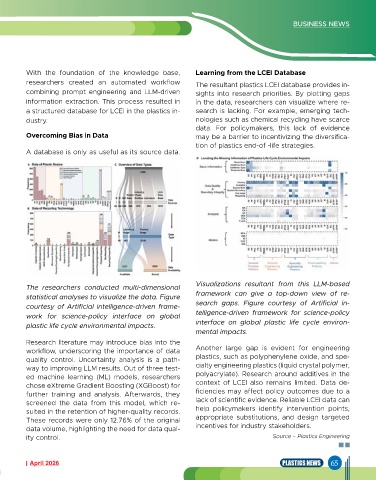
                                                                Visualizations resultant from this LLM-based
          The  researchers  conducted  multi-dimensional
          statistical analyses to visualize the data. Figure    framework can give a top-down view of re-
          courtesy of Artificial intelligence-driven frame-     search gaps. Figure courtesy of Artificial in-
          work for science-policy interface on global           telligence-driven framework for science-policy
          plastic life cycle environmental impacts.             interface  on  global plastic  life cycle  environ-
                                                                mental impacts.
          Research literature may introduce bias into the
          workflow, underscoring the importance of data         Another  large gap  is evident  for engineering
          quality  control. Uncertainty  analysis  is a path-   plastics, such as polyphenylene oxide, and spe-
          way to improving LLM results. Out of three test-      cialty engineering plastics (liquid crystal polymer,
          ed machine learning (ML) models, researchers          polyacrylate). Research around additives in the
          chose eXtreme Gradient Boosting (XGBoost) for         context of LCEI also remains limited. Data de-
          further  training  and  analysis.  Afterwards,  they   ficiencies may affect policy outcomes due to a
          screened the data from this model, which re-          lack of scientific evidence. Reliable LCEI data can
          sulted in the retention of higher-quality records.    help policymakers identify intervention points,
          These records were only 12.76% of the original        appropriate substitutions, and design targeted
          data volume, highlighting the need for data qual-     incentives for industry stakeholders.
          ity control.                                                                   Source – Plastics Engineering


           April 2026                                                                        PLASTICS NEWS  65

