


Page 53 - Plastics News - April 2026
P. 53
FEATURE NEWS


          eters in real time. By acknowledging deviations       scrap.
          and providing recommendations, the  system
          reduces quality variations before they result in      The Upstream Mind Shift
                                                                The system compares all target and actual val-
                                                                ues with a defined reference, similar to a tradi-
                                                                tional quality control process. However, the main
                                                                advantage here is that the recognition of quality
                                                                issues occurs online. As a result, operators can
                                                                correct the root causes of problems directly in
                                                                the machine instead of inspecting components
                                                                after they are molded. Ultimately, this shifts qual-
                                                                ity management one step upstream, ensuring
                                                                dimensional stability and preventing flow marks
                                                                before the cycle finishes.

                                                                                         Source – Plastics Engineering


          THE REGULATORY BLIND SPOT IN PLASTIC DESIGN


                                                                slowly, often through voluntary programs and in-
                                                                dustry pledges. That focus is shifting.


                                                                Yet regulators are increasingly converging on
                                                                a quieter vulnerability in plastic products. Ad-
                                                                ditives, colorants, fillers, and effect pigments
                                                                increasingly define whether a plastic product
                                                                complies with the law. These materials give plas-
                                                                tics their performance and appearance. They
                                                                also introduce chemical, safety, and recycling
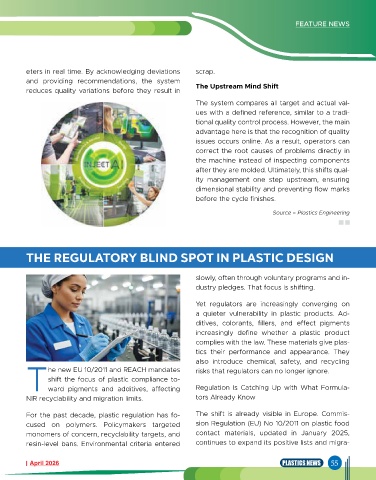
                 he new EU 10/2011 and REACH mandates           risks that regulators can no longer ignore.
                 shift the focus of plastic compliance to-
          Tward pigments and additives, affecting               Regulation Is Catching Up with What Formula-
          NIR recyclability and migration limits.               tors Already Know

          For the past decade, plastic regulation has fo-       The shift is already visible in Europe. Commis-
          cused on polymers. Policymakers targeted              sion Regulation (EU) No 10/2011 on plastic food
          monomers of concern, recyclability targets, and       contact materials, updated in January 2025,
          resin-level bans. Environmental criteria entered      continues to expand its positive lists and migra-


           April 2026                                                                        PLASTICS NEWS  55

